
Learn Balti with OpenBalti
Preserving our language through knowledge and technology.
"Start your journey to learn the Balti language — from script and grammar to real expressions deeply rooted in the culture of Baltistan."Start Learning →
"Every language carries a world within it — to learn Balti is to step into the soul of the mountains."— OpenBalti Community
The Path to Learning Balti
Balti is one of the oldest surviving forms of the Tibetan language, with its own unique script, sounds, and grammar. Through OpenBalti, we aim to make it easy for learners to explore this heritage — step by step, from alphabets to fluent communication. You’ll not only learn how it’s spoken but also understand the stories and traditions interwoven with each word.
Balti Script (བལྟི)
Discover the original Tibetan-based Balti script and how each letter connects to sound and meaning.
Pronunciation
Master the distinctive sounds of Balti with detailed guides on vowels, consonants, and regional variations.
Balti Dialects
Explore the regional variations and unique dialects of Balti spoken across Baltistan — each with its own tone and expression.
Grammar & Structure
Explore how Balti sentences are formed: nouns, verbs, tenses, and the natural rhythm of speech.
Phrases & Usage
Practice common Balti expressions for greetings, travel, and emotions — with English translations.
Culture & Heritage
Discover the traditions, customs, festivals, and cultural practices that shape the Balti people and their language.
Featured Lesson — Grammar Basics
Dive into the structure of Balti sentences — how subjects, verbs, and particles create balance and meaning. This lesson lays the foundation for understanding how Balti reflects thought and identity.
Start Lesson →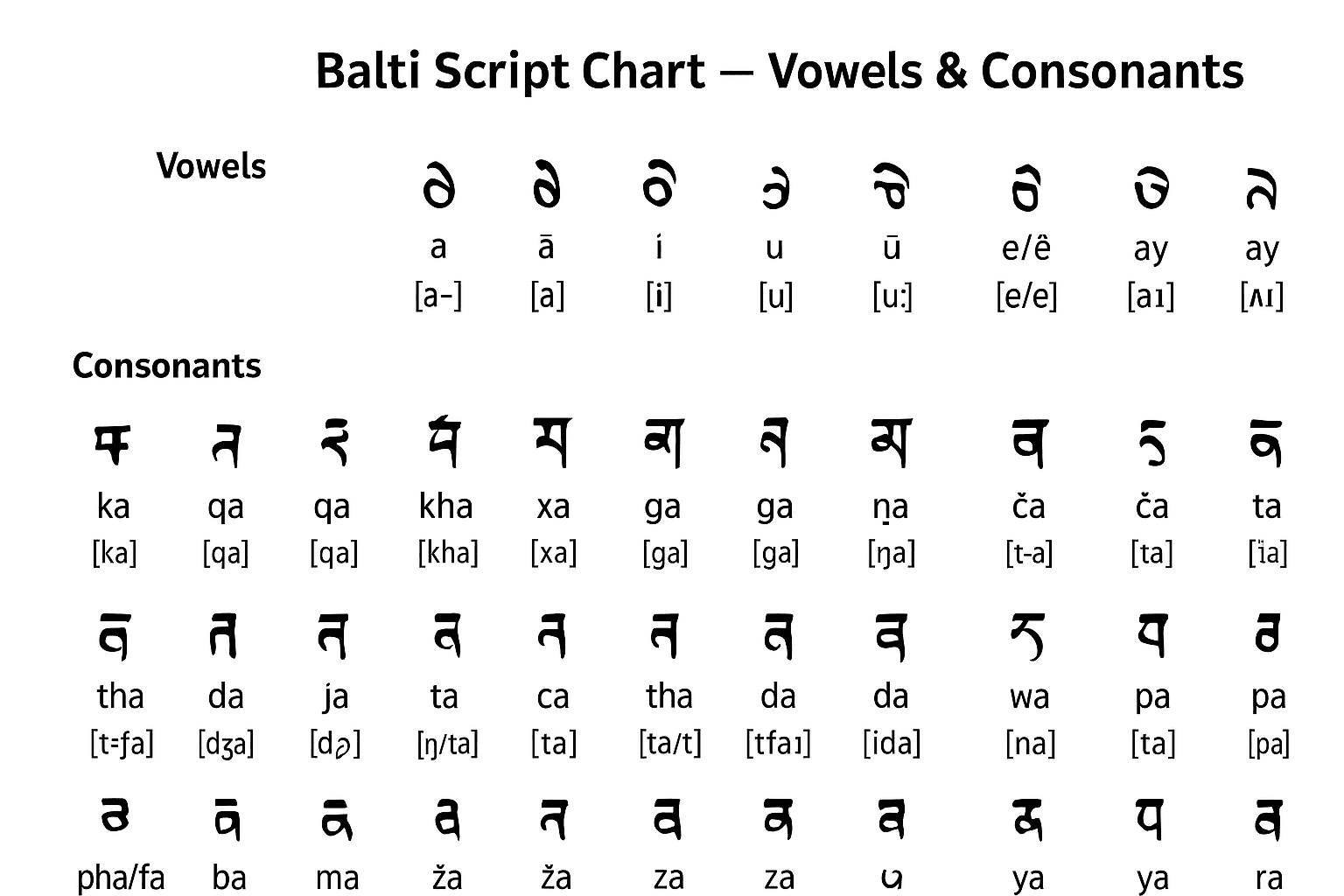
Comprehensive Learning Guides
Pronunciation Master Class
Deep dive into Balti phonology with audio examples, stress patterns, and regional accent variations from expert linguists.
Learn →Complete Grammar Reference
Master verb conjugation, word order, cases, and tenses with detailed explanations and practice sentences for every concept.
Learn →Learning Resources Hub
Access all learning materials, community guides, FAQs, and connections with native speakers in one organized hub.
Explore →Language Reflects Culture
Every Balti word carries a story — of respect, kinship, and connection to the mountains and the divine. Through learning, we don't just preserve vocabulary; we sustain a living culture and worldview passed down through generations.
How You Can Learn & Contribute
Follow Lessons
Explore Balti step by step — from script to fluent expression, all in one place.
Contribute Examples
Add real-world examples or cultural meanings to help enrich the learning experience.
Share Knowledge
Share what you learn with others — your words might inspire someone to reconnect with their roots.
Frequently Asked Questions
Everything you need to know about learning the Balti language, using OpenBalti, and contributing to language preservation.
Getting Started
OpenBalti is a free, open-source digital dictionary and learning platform dedicated to preserving and promoting the Balti language. It's designed for native Balti speakers wanting to document their language, learners interested in Balti culture, linguists researching Tibetic languages, and the global Balti diaspora seeking to reconnect with their heritage.
Learning speed varies from person to person. With consistent daily practice using OpenBalti's resources, you can start forming basic Balti phrases within a few weeks. Becoming comfortable with grammar, pronunciation, and script may take a few months of steady progress. Our structured lessons on script, grammar, and phrases are designed to guide you step by step.
Language & Culture
Yes — Balti originates from Classical Tibetan and is classified as a Tibetic language. It has evolved over centuries with influences from Persian, Urdu, and local Himalayan languages. While it shares Tibetan roots and uses a Tibetan-based script (Yige), it's now a distinct language with its own pronunciation, vocabulary, and grammar that beautifully reflects the unique culture of Baltistan.
The Balti script (བལྟི), also known as Yige or Bhoti script, is based on the Classical Tibetan writing system. It dates back to the 8th century and includes unique letters and pronunciation rules that connect deeply with Balti identity. OpenBalti teaches both the traditional Yige script and Romanized Balti, making the language accessible to all learners.
Yes, there are four main dialectal variations: Eastern (Chorbat, Nubra Valley), Central (Khaplu Valley), Western (Skardu, Shigar, Rondu), and Southern (Upper Kharmang, Kargil). These dialects differ mainly in pronunciation and some vocabulary, but all Balti speakers can understand each other easily. The Skardu dialect is often considered the prestige dialect.
Balti faces challenges from urbanization, migration, and the dominance of languages like Urdu and English. However, it remains actively spoken by hundreds of thousands of people in Baltistan and among diaspora communities. Projects like OpenBalti are working to document and revitalize the language, ensuring it thrives for future generations.
Learning Resources
No — OpenBalti is designed for complete beginners with no prior knowledge of Tibetan or any related language. All lessons are fully in English, and we teach everything from pronunciation to grammar step by step. While knowing Tibetan might help with script recognition, it's not required.
Yes! OpenBalti uses Romanized Balti to make the language accessible to everyone. You'll learn both writing systems — Romanized transcription and the traditional Balti Yige script — side by side, allowing you to read and write Balti regardless of your background.
Yes! We're actively developing an audio lessons feature with recordings from native Balti speakers. Current lessons include phonetic spellings and pronunciation guides. In the meantime, you can also find traditional Balti songs and storytelling videos on YouTube to hear native pronunciation.
Definitely! Our lessons are designed to be simple, visual, and engaging, making them ideal for children and families who want to reconnect with their Balti roots. Parents can use OpenBalti alongside their children to learn together and keep the language alive in their households.
Contributing
OpenBalti is a community-driven project that welcomes contributions from everyone. You can add new words to the dictionary, suggest corrections, contribute example sentences, share cultural context, or help with technical development on GitHub. Every contribution helps preserve and share the Balti language with the world.
OpenBalti uses a community review system where contributions are reviewed and validated by native speakers and language experts. Users can also rate entries as helpful, trusted, or needing review. This collaborative approach ensures the accuracy and quality of our dictionary while allowing the community to participate in language preservation.
Technical
Yes! The Balti Yige script is supported in Unicode. You can use Tibetan-based fonts to type in Balti script. We're also developing a dedicated Balti Keyboard feature for OpenBalti. For now, many users type in Romanized Balti which works on any standard keyboard.
Yes, OpenBalti is completely free and open source under the MIT License. You can use all features, access all dictionary entries, and learn from all our resources without any cost. The project is sustained by community contributions and the dedication of our volunteers.
Still have questions?
Can't find what you're looking for? We're here to help with any questions about Balti language learning or the OpenBalti platform.
Contact Us